 Dmail
Dmail NFT domains and permanent point imports
Updated on
Dmail NFT domains linked personalized email identities to transferable NFTs whose point attributes determined mailbox tiers. Binding activated a domain for email use. Imported task points became on-chain NFT properties, and the point rules prohibited cancelling an import. Those points stayed with the asset when its holder transferred or sold it. Dmail announced a wind-down beginning May 15, 2026, and instructed users to export their mail before that cutoff. That deadline has passed.
The active domain’s points shaped mailbox privileges
The point value of the NFT domain that an account actively bound determined its mailbox tier and the associated service privileges.
Initial domain attributes
Domain choice supplied the starting point attributes, while later imports added earned points to the same asset. The domain design linked initial points and presale prices to its name-length categories. Shorter names offered fewer possible combinations and carried different starting allocations. That relationship concerned the published domain categories; it did not establish an eventual resale price.
Tier-specific service limits
Mailbox tiers set daily sending limits, encrypted storage allowances, and task-reward coefficients. The active NFT’s point attributes therefore affected mail capacity and rewards for tasks that met their conditions. More points corresponded to higher account levels and their privileges. A domain’s original category described its starting attributes, while its accumulated points described its later tier-related state. The matching tier’s privileges supplied the actual email quota and storage allowance. Name length alone could not explain an account’s later benefits after point imports changed the NFT’s attributes.
Binding activated the personalized email account
Binding activated an acquired NFT domain as a personalized email account within Dmail, connecting the owned asset with the address that the mailbox used for correspondence. Alongside presale purchases, Dmail offered activity-based free mints to qualifying new users. The documented free-mint route set the domain price to zero but still required network gas. Ownership supplied asset control; binding supplied email activation. Those domain accounts supported email exchange with Web3 and conventional addresses. Web3 messages to an NFT-domain recipient required the account and its Principal ID (PID). That matching check resolved the intended recipient. Project subscriptions supplied another mailbox function, carrying updates from projects that users selected.
Point imports committed rewards to the NFT
A point import recorded earned rewards in the actively bound NFT’s on-chain attributes, which the account-tier system used to assign mailbox benefits.
Rewards credited to the account
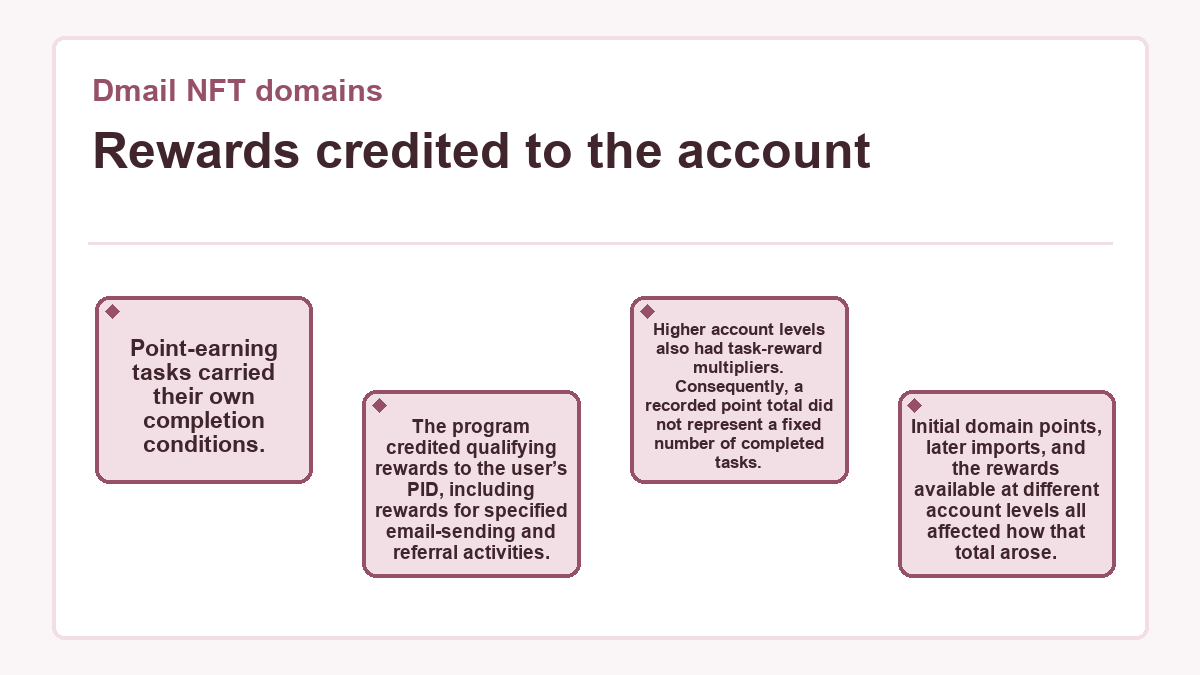
Point-earning tasks carried their own completion conditions. The program credited qualifying rewards to the user’s PID, including rewards for specified email-sending and referral activities. Higher account levels also had task-reward multipliers. Consequently, a recorded point total did not represent a fixed number of completed tasks. Initial domain points, later imports, and the rewards available at different account levels all affected how that total arose.
The bound NFT as the import target
The import dialog identified the currently bound domain, alongside its existing points and level. The entered amount described the requested addition to that NFT. Completion required writing the points into its on-chain attributes. The system then adjusted the account level from the domain’s updated points. An input amount in the dialog therefore described a requested import; the recorded NFT attribute represented the completed write.
The point rules prohibited cancelling an import after it wrote points into the NFT’s on-chain attributes. The operation committed those rewards to a particular asset. This made the selected domain material to the account-tier calculation and to any later ownership change.
Transfers preserved the NFT’s point attributes
Imported points remained in the NFT’s attributes when its owner transferred or sold the domain. Dmail matched the new PID’s account level to those points after the recipient bound the domain to that account. The existing point attribute could therefore contribute to the recipient’s mailbox benefits. The asset’s point history and the recipient’s own history of earning rewards could therefore differ.
Did a high point total prove that the holder earned it?
A retained point total did not prove that the NFT’s holder personally completed the tasks that originally produced its imported points.
Inherited points and the recipient’s tier
In this hypothetical example from Dmail’s operating period, a buyer received an NFT domain that already contained points imported by its previous holder. The buyer bound the domain to their own PID. The question was whether its point total represented the buyer’s task history or attributes that the domain carried through the sale.
Dmail matched the buyer’s account level to the retained points of that bound NFT. The buyer therefore received the corresponding tier benefits even though a previous holder had earned the imported rewards. The program had credited the original task rewards to the previous holder’s PID. The NFT’s retained total explained the new account’s tier without establishing that its holder had completed those earlier tasks.
That tier outcome required the domain binding and an operating Dmail service. The retained attribute alone could not establish mailbox availability after the announced wind-down.
Domain attributes and mailbox availability followed different rules
In April 2026, Dmail announced a gradual service wind-down beginning May 15, 2026. Users received instructions to export their email before that cutoff. The notice said that nodes would stop and messages would become inaccessible afterward. That was an email-access deadline, separate from the historical rule that point imports persisted in NFT attributes.
The point attribute described a tier-related property of the asset. Email access depended on the infrastructure that resolved accounts and served stored messages. A retained NFT record did not demonstrate a working inbox, an available export function, or continued tier processing after the announced cutoff.
The default address and activated DIDs offered other identities
The default wallet-linked address and activated decentralized identifiers (DIDs) offered other email identities, while NFT domains combined personalized names with transferable assets and tier-related point attributes. Dmail created the default email address at first login. Users could also activate supported DIDs that their logged-in wallet held.
An NFT domain added a named asset whose recorded points could change through imports and remain through transfers. Its use as an email account still required binding within Dmail. The default address supplied an automatically created email identity, and DID activation used an existing supported identity.
What to know about Dmail NFT domains
-
How much did a four-digit NFT domain cost in Dmail’s presale schedule?
- The historical presale schedule listed a four-digit NFT domain at 199.99 USD, with 10,000 initial points. Those figures described the listed purchase category before the announced wind-down. The starting allocation contributed to the domain’s tier-related attributes, and earned-point imports could later add to them. The listed price did not establish a resale value or a currently available mint.
-
Did signing in qualify an account to earn points for its NFT domain?
- Signing in alone did not meet Dmail’s requirements for participating in point earning. The point program also required successfully binding an NFT, followed by completing tasks that met their individual conditions. Binding did not automatically award every task’s points or establish that a referral or email-sending task had succeeded.
-
Could Dmail reset an invitation-code task that failed because of the invited user’s actions?
- Dmail’s point rules rejected a reset when an invitation-code task failed because the invited user did not complete it correctly. That condition concerned earning the referral reward before any import into a domain. It did not describe an undo mechanism for points that the account had already imported into the NFT.
-
Were future airdrops guaranteed for an NFT domain with imported points?
- Imported domain points did not guarantee a future airdrop allocation. Dmail treated engagement points as a possible basis for later rewards, while the domain’s recorded points also served its account-tier system. A permanent point attribute did not specify an allocation amount, claim date, or distribution commitment.
-
Which characters did activity-based NFT domain names allow?
- The demonstrated activity-based minting interface accepted numbers and letters and treated domain names as case-insensitive. Changing capitalization therefore did not create a different name in that interface. Activities also had their own identity, wallet, network, or whitelist requirements. The naming rule alone did not establish eligibility for a free mint.